With the men’s World Cup and the women’s qualifiers underway, attention is once again turning to football’s familiar dramas. Yet beyond the touchline, another story has been unfolding: the changing headline coverage of motherhood in elite sports. Once framed as a career-ending detour, motherhood is increasingly portrayed as a source of resilience and renewal. The media has played a pivotal role in that shift, shaping not only public opinion, but the opportunities afforded to female athletes.
The power of the press
Historically, motherhood and elite sports have been thought of as incompatible, with pregnancy described as ‘the kiss of death’ to the career of the female athlete.1 Once pregnant, the media portrayed athletes as retiring, settling down or prioritising family over competition, entrenching the assumption that having children marks the natural endpoint of a woman’s sporting career.
An early exception was Fanny Blankers-Koen. In the run up to the 1948 Olympics, media coverage often referred to her as the ‘Flying Housewife,' a nickname that simultaneously celebrated her athletic prowess and reflected the era’s tendency to frame female achievement through the lens of domestic identity. She went on to win four gold medals.2
Despite the success of Blankers-Koen, the media’s choice of language reinforced the notion that motherhood and elite sport were fundamentally at odds, casting Blankers-Koen as exceptional precisely because she was a mother. That same framing persisted for several decades and can still be spotted today. Sponsors, governing bodies and even athletes themselves would speak of motherhood as the effective end of a sporting career.
Part of this perception stemmed from a biological reality that was often overstated: pregnancy and childbirth place considerable demands on the body, and recovery can take months or even years. Yet the assumption that motherhood necessarily entails an irreversible decline in performance became entrenched long before it was rigorously tested.
The impact was tangible: athlete-mothers lost sponsorship pay, received less media coverage and faced pressure to retire early. Until recently, sponsorship contracts routinely included maternity clauses that allowed payments to be reduced or withdrawn during pregnancy. When American sprinter Allyson Felix, the most decorated woman in Olympic athletics history, informed Nike in 2018 that she was pregnant, the company proposed a 70% pay reduction – reflecting the widespread belief that motherhood diminished an athlete's competitive and commercial value.
Postnatal fitness
So, what does the science say? Due to the physiological demands of pregnancy and childbirth, motherhood has often been treated as a permanent competitive hindrance in elite sport. In practice, the physical effects can be largely transient. While recovery requires time, many athletes can return to pre-pregnancy levels of fitness through structured, targeted rehabilitation, particularly of the pelvic floor, core and musculoskeletal system.4 Although individual outcomes vary and recovery can be complicated by a range of postpartum conditions. Crucially, return to peak fitness is highly dependent on an athlete’s access to multidisciplinary support (coaches, sports physicians, and physiotherapists) who can individualise training and monitor injury risk.4 The evidence suggests that a successful return is more closely associated with the quality of structured training and support than with pregnancy-related physiology itself.
Strikingly, research suggests that motherhood does not diminish the performance of high-level female athletes and may, in some cases, even enhance it.3 This is attributed not only to physical recovery and training adaptation, but also to psychological changes. In a qualitative 2024 study of diverse elite athletes, mothers interviewed put their enhanced performance down to a shift in focus from themselves to their child, describing heightened motivation and diminished pressure.3
The remarkable story of Claire Emslie, the Scotland forward, who will return to the 2026 World Cup qualifiers just six months after giving birth brings this home. This is not to suggest that such a timeline should be the norm, but it refutes the assumption that motherhood and elite competition are mutually exclusive.
Booting out old assumptions
Emslie’s story sits within a broader lineage of women who have challenged long-held perceptions over decades, driving changes in policy, research and the development of women’s sports. In 2007, Paula Radcliffe won the New York City Marathon less than 10 months after giving birth – a feat that she then repeated the following year. A decade later Serena Williams returned to tennis after a life-threatening childbirth and went on to reach four Grand Slam finals. Williams spoke openly about postpartum recovery, breastfeeding and maternal health, helping to bring into public view aspects of the female body that had long been absent from mainstream sports coverage.
These accounts are among a growing body of examples of women returning not merely to competition, but to peak performance. In many cases, they have matched or surpassed their pre-pregnancy achievements, setting personal bests, winning major titles, and demonstrating that motherhood is not a barrier to sporting excellence.
However, media coverage has not always kept pace with these changes. During a US television broadcast of the 2016 Olympics, female athletes were frequently framed in relation to their roles as wives and mothers, rather than by their sporting abilities.5 This is still the case: an analysis of 241 Instagram posts by Spanish media outlets covering the 2024 Paris Olympics had similar findings.6 This shows that outdated framings in sports journalism continue to lag behind, even in the face of the consistently exceptional achievements of athletes after becoming mothers. In this respect, contemporary coverage often echoes the treatment of Blankers-Koen nearly seven decades earlier.
Levelling the playing field
Athletes such as Allyson Felix and Shelly-Ann Fraser-Pryce have attracted attention not only for their sporting success, but also for challenging the structural disadvantages faced by mother-athletes. Fraser-Pryce, the third fastest sprinter in history, spoke up about the pressure she faced to retire when she fell pregnant in 2017, helping to prompt wider changes in policy and practice.7
The year after giving birth to her first child, Felix broke Usain Bolt's gold medal record at the 2019 World Athletics Championship, and a year later became the most decorated track and field athlete in US history at the 2020 Tokyo Olympics. Felix publicly blew the whistle on her sponsor, Nike, for proposing pay reductions linked to pregnancy and maternity. Her stance helped drive a major shift among athletic brands, with several changing their policies around pay and protections for pregnant athletes and helped kick off wider improvements in maternity.8
Building on the growing number of successful sporting returns after childbirth, alongside the pressure exerted by athletes such as Felix and Fraser-Pryce, the media narrative around motherhood in elite sport has begun to shift, with the ‘kiss of death’ framing increasingly challenged. Yet the underlying logic has often persisted in new form. Women who return to competition are frequently cast as ‘super mums’9,10,11 making remarkable ‘comebacks.’11 While this narrative celebrates individual resilience, it risks reinforcing the idea that such returns are extraordinary rather than normal. And in doing so, it subtly preserves the underlying assumption that motherhood and elite performance are inherently in tension – which the evidence says are not.
Delivering for sportswomen
Today, motherhood is increasingly viewed as a stage of life compatible with an elite sporting career. Support for athlete-mothers has expanded, aided by advances in sport science including a better understanding of exercise during pregnancy and the postnatal period, improved nutritional guidance and more comprehensive maternity leave policies. These developments reflect a growing shift towards evidence-based support for athlete-mothers.13 Progress is continuing at the institutional level too. Recently, FIFA expanded its previous 2020 framework to include adoption leave, family leave, breastfeeding accommodations, menstrual-health provisions and additional protections for female players and coaches.
These changes are also reflected in contemporary sports media, where reporting is slowly beginning to align with the idea of motherhood as just another chapter in an athletic career.
Announcing a return to competitive tennis at Wimbledon next month aged 44, four years after her final match at the 2022 US Open, Serena Williams continues to defy the perception of what an elite athlete looks like. And in women’s football, Claire Emslie is just one name among several mothers set to represent their country in the World Cup qualifiers.
Williams and Emslie are not exceptions to be framed as ‘super mums’, but elite athletes who also happen to be mothers. The remarkable thing is not that mothers can compete at the highest level, but that this still attracts surprise.
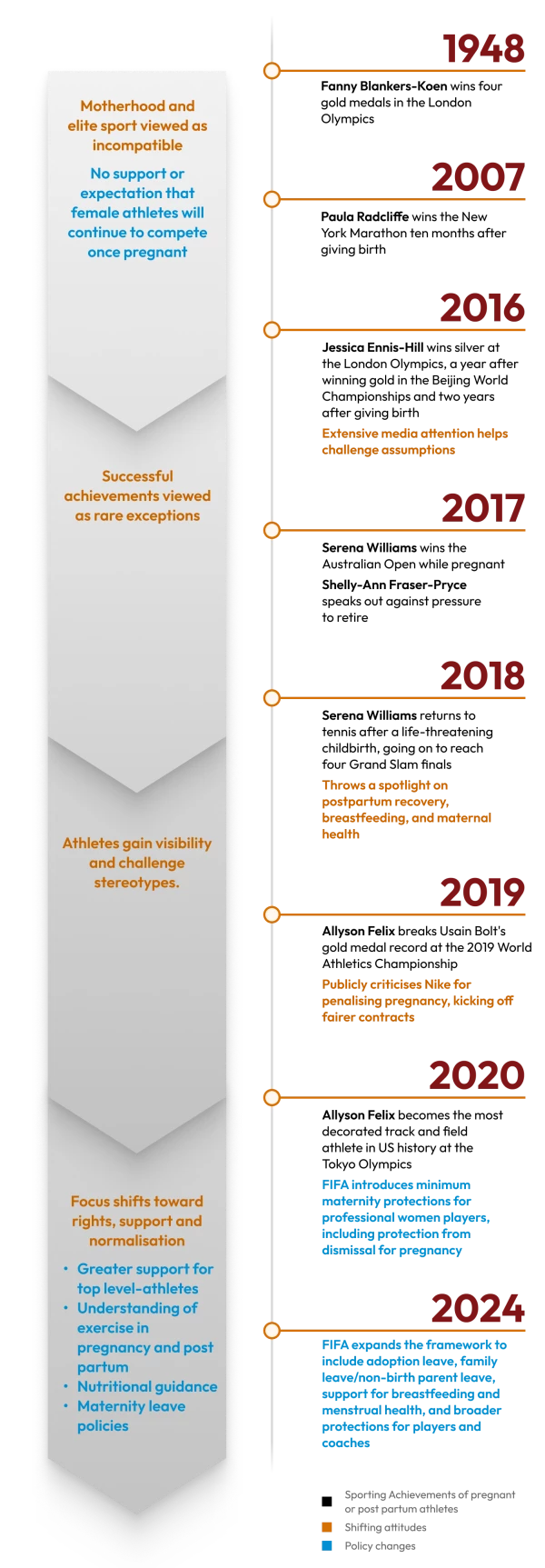
A shifting landscape: the gradual recognition and protection of motherhood in elite sport
By Nicola Joseph
References
- Business Insider. 2026. Allyson Felix said getting pregnant is known as 'the kiss of death' for Olympic track and field athletes: https://www.businessinsider.com/allyson-felix-getting-pregnant-kiss-of-death-for-olympic-runners-2022-4
- European Olympic Academies.2022. Fanny Blankers-Koen: https://www.eoaolympic.org/olympic-person/fanny-blankers-koen/
- McGregor B et al. Exploring pregnancy and postpartum experiences among geographically diverse elite athletes: A qualitative study. Journal of Science and Medicine in Sport. 2024; (28):101–109.
- Woodroffe L et al. Return to Running for Postpartum Elite and Subelite Athletes. Sports Health. 2025;17(3):614–620.
- Villalon C et al. NBC’s televised media portrayal of female athletes in the 2016 Rio Summer Olympic Games: a critical feminist view. Sport in Society. 2018;21(8):1137–1157.
- Castro-Lemus N et al. Women athletes’ representation on Instagram: A feminist critical discourse analysis of Spanish media coverage during the Paris 2024 Olympics. International Review for the Sociology of Sport. 2025;61(2): 321–343.
- BBC. 2021. Allyson Felix and Shelly-Ann Fraser-Pryce on motherhood, sexism and postponed Olympic Games. https://www.bbc.co.uk/sport/athletics/55677427
- BBC. 2019. Allyson Felix: Nike changes policy for pregnant athletes. https://www.bbc.co.uk/sport/athletics/49380550
- The Athlete. 2026. Super mom: Italy’s Francesca Lollobrigida wins 5000m to claim second gold: https://www.nytimes.com/athletic/7042098/2026/02/12/francesca-lollobrigida-wins-5000m-olympics-gold-italy/
- Olympics. 2024. Supermom Jessica Stenson beats Paris 2024 Olympics marathon entry standard in Daegu: https://www.olympics.com/en/news/jessica-stenson-australia-paris-2024-olympics-entry-standard-marathon
- DW. 2023. Meet the 2023 FIFA Women’s World Cup Supermoms: https://www.dw.com/en/meet-the-2023-fifa-womens-world-cup-supermoms/g-66201531
- BBC. 2023. Laura Gallagher: Olympic gymnast on her 'surprise' comeback after becoming a mum: https://www.bbc.co.uk/sport/gymnastics/67349585
- Caro CV et al. Returning to sport after pregnancy: A qualitative study of elite female athletes in the UK. Journal of Science and Medicine in Sport. 2026;29(5):566–575.