
Introduction
They say doctors make the worst patients, but what if you are both your own doctor and the patient? Potentially rarer than the disease itself, this article tells the story of one man chasing his cure after facing the prospect of death five times over.
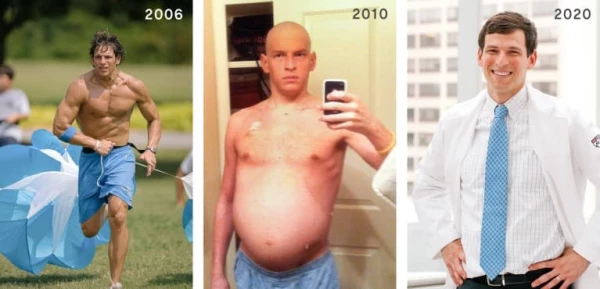
Fighting for a Cure
Dr. David Fajgenbaum went into multi-organ failure in his third year of medical school.1 Little did he know that he was about to spend the next chapter of his life fighting to survive, using himself as his own test subject. At this time, medical knowledge surrounding Castleman disease (CD) was lacking, so Dr. Fajgenbaum took it upon himself to find the cure for CD.
What Is CD?
CD is a rare lymphoproliferative disorder, where the immune system becomes hyperactive and attacks vital organs. This can have potentially fatal consequences.1,3 It can be classified into unicentric Castleman disease or multicentric Castleman disease, with further sub-divisions based on the aetiology. CD symptoms vary but are largely characterised by enlarged lymph nodes in a single region of the body, such as the abdomen (see middle picture above). Reportedly, CD shows no gender bias, and the estimated annual incidence in the US is ~4300–5200, and in the UK ~1100–1300 patients.4,11 The specific aetiology is yet to be elucidated.9
The Latest in the CD Research Landscape
Dr. Fajgenbaum recently published a paper that explored factors that may be associated with mortality rates of CD patients. Research was carried out using the ACCELERATE registry, an international registry with the largest cohort of CD patients to date.3,9,10 The researchers analysed deceased patients together with control patients who were matched based on disease type, age and severity. The paper illustrated new parameters that appeared potentially more specific to the deceased population such as significantly lower immunoglobulin M, international normalised ratio and platelet count. Overall, the paper indicated potential differences between fatal and non-fatal outcomes, which could have huge implications for regular monitoring and the treatment course of patients suffering from CD.3,10
Treatment
As a consequence of their scarcity and complex nature, rare diseases such as CD remain difficult to treat.6 Siltuximab is the only first-line Food and Drug Administration (FDA) or European Medicines Agency-approved idiopathic multicentric Castleman disease (iMCD) treatment. In particularly severe cases of CD, chemotherapy is also necessary.3 However, siltuximab is only effective in ~34–50% of iMCD patients, which was the case for Dr. Fajgenbaum, who was unable to be treated using siltuximab.2,9 However, through his research within the Castleman Disease Collaborative Network (CDCN), he identified that the pattern of vascular endothelial growth factor and T-cell activation are key components of the disease mechanism of action and that the overactivity of the mammalian target of rapamycin (mTOR) pathway plays a significant role in the disease process.2,5 Through this, he identified a treatment known as sirolimus (also known as rapamycin), a drug that inhibits the mTOR pathway, and has been in remission ever since.7 Consequently, sirolimus is also undergoing clinical trials to be established as an FDA-approved treatment of CD.2
Conclusion
The low prevalence of rare diseases such as CD poses a further issue for drug development. Owing to the limited number of patients who require these treatments and financial implications of developing a medicine for a small demographic, therapeutics around rare diseases are often underdeveloped. At present, 90% of known rare diseases still lack treatment.8
Dr. Fajgenbaum’s experience illustrates that there is hope for those with rare diseases, but there is still a long way to go in order to increase the treatments available for those suffering from a rare disease. The particular CD subtype Dr. Fajgenbaum was diagnosed with has a 50% mortality rate in patients within 5 years of diagnosis, making it ever more pertinent to raise awareness and continue research into other forms of treatment for both iMCD and other iterations of CD.9
For further information about Dr. Fajgenbaum’s life with CD, please see his memoir and US national bestseller, ‘Chasing My Cure’.2 If you would like to know more about his research, please visit the CDCN website.5
Here at TVF, we have a vast amount of experience regarding rare diseases and a deep appreciation of the importance of medical communications in the rare disease field. The invaluable experience of our medical and client services team makes us ever more qualified to aid the development, communications and research surrounding the treatment and the discovery of rare diseases. To find out more about how we can support you, get in touch.
By Lily Finnigan
References
- https://chasingmycure.com/
- https://bnf.nice.org.uk/drug/sirolimus.html
- https://pubmed.ncbi.nlm.nih.gov/35507638/
- https://onlinelibrary.wiley.com/doi/10.1111/bjh.17688#bjh17688-bib-0002
- https://cdcn.org/
- https://www.nature.com/articles/s41431-019-0508-0
- https://www.ncbi.nlm.nih.gov/pmc/articles/PMC2698317/
- https://www.visualcapitalist.com/which-rare-diseases-are-the-most-common/
- https://www.ncbi.nlm.nih.gov/pmc/articles/PMC6265649/
- https://www.ncbi.nlm.nih.gov/pmc/articles/PMC7762771/
- https://ashpublications.org/blood/article/135/16/1353/452573/Overview-of-Castleman-disease