
The past decade has rewritten the story of hepatology as we’ve witnessed remarkable innovations emerge for chronic liver diseases, from obeticholic acid for primary biliary cholangitis to resmetirom for metabolic dysfunction-associated steatohepatitis. Yet many individuals fail to benefit from these scientific breakthroughs for a very simple reason: they remain undiagnosed.
How much of a failure is it exactly? We investigated to find the true extent of these ‘missing millions’, the reasons behind the numbers and the implications for a pharmaceutical industry facing limited patient volumes.
The hidden crisis
Early detection of chronic liver disease during its asymptomatic ‘phase zero’ could not only significantly expand the addressable patient population, but also save lives and prevent millions of quality-adjusted life-years (QALYs) from being lost. The industry usually only considers QALYs in the context of comparing two treatment regimens, but the QALYs lost from missed diagnosis is a crisis hiding in plain sight. Figure 1 illustrates not only the estimated number of undiagnosed patients across various chronic liver diseases, but also the QALYs lost from delayed diagnosis.
With innovative therapies now available, and more on the horizon, can we justify continuing to overlook these diagnoses? We’ve seen that early detection initiatives such as the UK NHS's ongoing programme to eliminate hepatitis C virus (HCV) benefit all stakeholders, from governments and nongovernmental organisations to pharmaceutical companies and patients alike. So could collaboration bridge the diagnostic gap in liver disease more generally, and what are the obstacles?
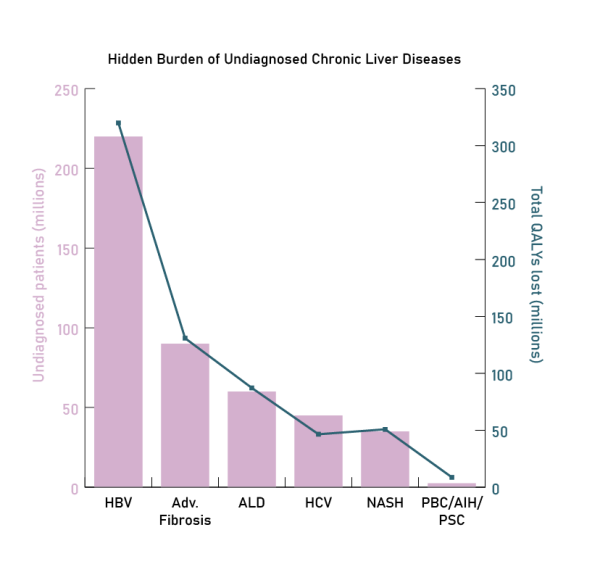
[Figure 1. The hidden crisis of undiagnosed chronic liver diseases. Bar heights (pink, left axis) represent the estimated number of undiagnosed patients (in millions) for each major chronic liver disease worldwide, based on global prevalence and diagnosis rate estimates (e.g. World Health Organization, EASL, American Association for the Study of Liver Diseases and published epidemiologic data). The blue line (right axis) shows the corresponding total quality‑adjusted life-years (QALYs) lost due to delayed or missed diagnosis. Together, these data highlight the disproportionate impact of missed detection – particularly for hepatitis B, advanced fibrosis and alcohol‑related liver disease – illustrating the urgent unmet need for earlier screening, diagnosis and intervention across the hepatology landscape.]
Root causes of underdiagnosis
As rare disease communication experts, we realise that underdiagnosis in liver disease often stems from structural and systemic barriers rather than just clinical complexity.
Care pathways are typically fragmented; primary care clinicians may detect subtle abnormalities, but these results rarely trigger specialist referral. Symptoms are frequently nonspecific, such as fatigue or mild discomfort, and clinicians face competing priorities. Electronic health records compound the problem; they are frequently siloed, poorly interoperable and fail to flag high‑risk patients. Specialist access can be limited, and screening incentives in primary care tend to prioritise diabetes or cardiovascular disease over liver health. Such diagnostic bottlenecks result in fewer than one in five patients with abnormal liver tests receiving appropriate follow‑up or fibrosis risk assessment.
These issues mean that early, reversible liver disease frequently goes undetected. Addressing these challenges requires coordinated action: standardised screening triggers, improved primary care decision‑support tools, better communication across care settings and integrated data systems that enable population‑level risk identification.
Promising initiatives already exist – for example, the NHS England initiative to eliminate HCV and its Liver Pathway Improvement Programme, which embed fibrosis scoring and electronic alert systems into primary care workflows to increase early detection. Similar pilots in the US, such as including automated FIB‑4 algorithms in electronic health records, have led to substantial improvements in case‑finding for nonalcoholic fatty liver disease and viral hepatitis. Without wider adoption of such integrated approaches, even the most effective therapies will continue to operate downstream of the real problem, reaching patients only after disease progression.
The role of the industry
We’ve already mentioned the pharmaceutical industry, but what exactly is its role in this diagnostic quagmire? The industry has traditionally focused on R&D, regulatory approval and market access, not patient finding, as the breadth of the problem seemingly makes direct engagement impractical. Yet this diagnostic gap directly limits the real-world reach of newly approved therapies, puts a ceiling on commercial potential and instils fierce competition for the small pool of existing diagnosed patients. Here, modest, targeted interventions could make a tangible difference. Companies can support awareness campaigns, create or fund registries, partner in screening initiatives or help to integrate data-driven tools in routine care, all with relatively little investment.
Evidence from national programmes shows that such partnerships can deliver measurable outcomes. For example, the UK’s initiative to eliminate hepatitis C, led by NHS England and supported by multiple pharmaceutical companies, mobilised both public and private investment to expand community screening, improve data integration and enhance linkage-to-care. Gilead Sciences and AbbVie collectively contributed tens of millions of pounds in kind and through programme support – funding mobile testing units and local engagement campaigns – that helped to drive a >90% reduction in untreated HCV infection among diagnosed patients between 2015 and 2022.
By contributing to patient‑finding efforts, pharmaceutical companies align ethical responsibility with commercial value: patients gain access to life‑changing therapies, healthcare systems become more efficient through earlier intervention, and the companies maximise the real-world impact and sustainability of their innovations.
Tactical possibilities
Tackling diagnostic bottlenecks requires collaboration beyond traditional competition. One approach between competing companies could be a shared pledge: ‘We don’t compete on who diagnoses.’ By focusing on pre-competitive areas such as patient-finding algorithms, registries and digital screening tools, companies can increase the diagnosed population without compromising brand competition. Public–private initiatives, such as the NHS programme to eliminate hepatitis C, have already demonstrated how pooling resources reduces investment risk while expanding reach.
Education programmes, primary care decision-support tools and interoperable data platforms can further accelerate early detection. Such approaches have the potential to transform diagnosis into shared infrastructure: when patients are found early, therapies are used more widely, patient outcomes improve and the market grows sustainably. Collaboration here isn’t a compromise – it’s a strategic enabler that benefits patients, health systems and all of the companies involved.
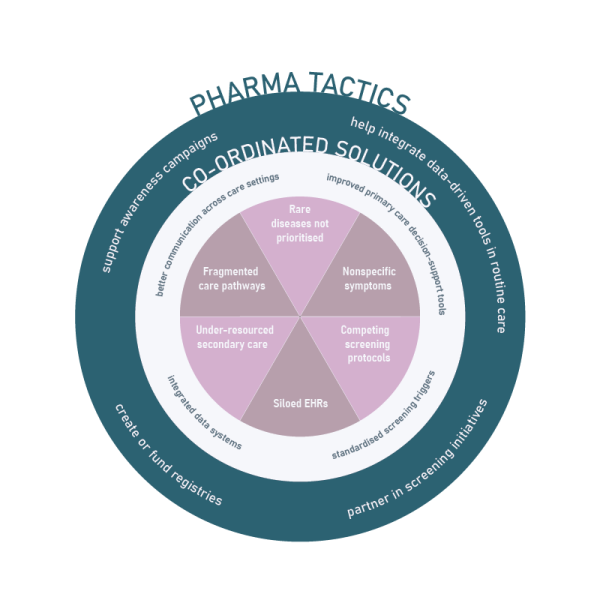
[Figure 2. Coordinated action to remove diagnostic gaps in chronic liver disease.]
Cultural blockers
What else could be holding pharmaceutical companies back? Collaboration in the pharmaceutical industry is often hampered by a competitive culture and regulatory caution. Companies worry that sharing diagnostic tools might inadvertently provide competitors with a market advantage or violate competition laws. Yet precedents exist: pre-competitive consortia in rare diseases, antimicrobial stewardship and COVID-19 collaborations have already shown that cooperation is possible when carefully structured. Regulatory frameworks generally permit joint initiatives that focus on education, disease awareness or patient identification (provided patient privacy is protected and commercial boundaries are maintained).
Overcoming cultural resistance requires strong leadership, clear governance and early wins to build trust. Success depends on reframing diagnosis as a shared responsibility rather than a proprietary asset: collaboration amplifies impact without compromising competitive integrity. With the right governance and regulatory safeguards, pharmaceutical companies can collectively expand early detection, improve patient outcomes and strengthen the market for therapies.
Summary
Liver disease has entered an era of unprecedented therapeutic progress, but the benefits are bypassing most patients. Despite groundbreaking advances in conditions such as primary biliary cholangitis, metabolic dysfunction-associated steatohepatitis and viral hepatitis, diagnosis remains a bottleneck that keeps such innovations from delivering their full impact. Millions live with undetected disease because healthcare systems are fragmented, incentives are misaligned and early warning tools are inconsistently used.
The result is a paradox, where scientific success coexists with stagnant patient volumes and lost QALYs. Yet this crisis holds opportunity. The experience of programmes such as the NHS initiative to eliminate hepatitis C shows that disease awareness, smart data integration and coordinated screening can rapidly transform outcomes.
The pharmaceutical industry has a critical, if unconventional, role to play. By investing in patient‑finding – not competitively, but collaboratively – companies can align commercial logic with public good. Shared registries, diagnostic algorithms and educational partnerships create value for all: patients receive timely intervention, healthcare systems ease downstream pressures and the industry realises the true potential of its innovations.
The message is unmistakable: diagnosis is no longer someone else’s problem. Making early detection a shared mission across industry, government and care settings is the next frontier in liver disease, and the key to turning medical breakthroughs into population‑level change.
By Azhaar Ashraf, Meer Basharat and Nicola Joseph
References
Figure 1:
Hepatitis B virus (HBV)
- European Association for the Study of the Liver. EASL 2017 clinical practice guidelines on the management of hepatitis B virus infection. Journal of Hepatology. 2017;67(2):370-398.
- Razavi-Shearer D, et al. Global prevalence, treatment, and prevention of hepatitis B virus infection in 2016: a modelling study. Lancet Gastroenterology & Hepatology. 2018;3(6):383–403.
- World Health Organization. Hepatitis B fact sheet (2023). https://www.who.int/news-room/fact-sheets/detail/hepatitis-b.
Advanced fibrosis (various aetiologies)
- Asrani SK, et al. Burden of liver diseases in the world. Journal of Hepatology. 2019;70(1):151–171.
- Pimpin L, et al. Burden of liver disease in Europe: epidemiology and analysis of risk factors to identify prevention policies. Journal of Hepatology. 2018;69(3):718–735.
- Tsochatzis EA, et al. Liver cirrhosis. Lancet. 2014;383(9930):1749–1761.
Alcoholic liver disease (ALD)
- Axley PD, et al. Alcoholic hepatitis: acute management and the case for specialized alcoholic hepatitis treatment programs. Seminars in Liver Disease. 2020;40(1):20–30.
- Seitz HK, et al. Alcoholic liver disease. Nature Reviews Disease Primers. 2018;4:16.
- Thursz M, et al. EASL clinical practice guidelines: management of alcohol-related liver disease. Journal of Hepatology. 2018;69(1):154–181.
Hepatitis C virus (HCV)
- Blach S, et al. Global change in hepatitis C virus prevalence and cascade of care between 2015 and 2020: a modelling study. Lancet Gastroenterology & Hepatology. 2022;7(5):396–415.
- Polaris Observatory HCV Collaborators. Global prevalence and genotype distribution of hepatitis C virus infection in 2015: a modelling study. Lancet Gastroenterology & Hepatology. 2017;2(3):161–176.
- World Health Organization. Global Hepatitis Report 2021. https://www.who.int/publications/i/item/9789240027077.
Nonalcoholic/metabolic dysfunction-associated steatohepatitis (NASH/MASH)
- Estes C, et al. Modeling NAFLD disease burden in China, France, Germany, Italy, Japan, Spain, United Kingdom, and United States for the period 2016–2030. Journal of Hepatology. 2018;69(4):896–904.
- Younossi ZM, et al. Global epidemiology of nonalcoholic fatty liver disease – meta-analytic assessment of prevalence, incidence, and outcomes. Hepatology. 2016;64(1):73–84.
- Younossi ZM, et al. The economic and clinical burden of nonalcoholic fatty liver disease in the United States and Europe. Hepatology. 2016;64(5):1577–1586.
Primary biliary cholangitis (PBC)
- European Association for the Study of the Liver. EASL clinical practice guidelines: the diagnosis and management of patients with primary biliary cholangitis. Journal of Hepatology. 2017;67(1):145–172.
- Hirschfield GM, et al. The diagnosis and management of primary biliary cholangitis. Hepatology. 2017;67(1):349–369.
- Lu M, et al. Increasing prevalence of primary biliary cholangitis and reduced mortality with treatment. Clinical Gastroenterology and Hepatology. 2018;16(8):1342–1350.
Autoimmune hepatitis (AIH)
- European Association for the Study of the Liver. EASL clinical practice guidelines: autoimmune hepatitis. Journal of Hepatology. 2015;63(4):971–1004.
- Grønbæk L, et al. Autoimmune hepatitis in a European country: a review. Journal of Hepatology. 2014;60(5):923–927.
- Mack CL, et al. Diagnosis and management of autoimmune hepatitis in adults and children: 2019 practice guidance and guidelines from the American Association for the Study of Liver Diseases. Hepatology. 2020;72(2):671–722.
Primary sclerosing cholangitis (PSC)
- Boonstra K, et al. Population-based epidemiology, malignancy risk, and outcome of primary sclerosing cholangitis. Hepatology. 2013;58(6):2045–2055.
- Lindor KD, et al. Primary sclerosing cholangitis: 2021 practice guidance from the American Association for the Study of Liver Diseases. Hepatology. 2022;75(4):1062–1094.
- Molodecky NA, et al. Incidence of primary sclerosing cholangitis: a systematic review and meta-analysis. Hepatology. 2011;53(5):1590–1599.
Root causes of underdiagnosis:
- Alexander M, et al. Real-world data reveal a diagnostic gap in nonalcoholic fatty liver disease. Hepatology Communications. 2021;5(6):939–952.
- Cholankeril G, et al. Healthcare utilization and barriers to care among patients with chronic liver disease. Hepatology Communications. 2019;3(2):205–216.
- Moriarty K, et al. Delivering hepatitis C elimination – how partnerships between the NHS, public health teams and industry are supporting national targets. Frontline Gastroenterology. 2022;13(2):130–134.
- Newsome PN, et al. FibroScan‑AST (FAST) score for the non‑invasive identification of patients with non‑alcoholic steatohepatitis and significant fibrosis: a prospective derivation and global validation study. Lancet Gastroenterology & Hepatology. 2020;5(4):362–373.
- Public Health England. Hepatitis C in England 2023: working to eliminate hepatitis C as a major public health threat. UK Health Security Agency; 2023.
- Riley TR, Smith JP. Preventive care in chronic liver disease: how frequent and how effective are current practices? Journal of Clinical Gastroenterology. 2017;51(10):835–840.
- Sheron N, et al. Abnormal liver function tests in primary care-investigations, outcomes, and survival: a cohort study using electronic medical records. BMJ Open Gastroenterology. 2019;6(1):e000262.
- Williams R, et al. Guidelines on the management of abnormal liver blood tests. Gut. 2018;67(1):6–19.
- World Health Organization. Global Hepatitis Report 2021: pathways to early diagnosis and cure. Geneva: WHO; 2021.
The role of the industry:
- AbbVie UK. Working in partnership to eliminate hepatitis C in England. Corporate responsibility report 2022.
- Gilead Sciences. Gilead Sciences supports NHS England’s Hepatitis C elimination goals through community testing and linkage-to-care initiatives. Company press release. 2020.
- Moriarty K, et al. Delivering hepatitis C elimination – how partnerships between the NHS, public health teams and industry are supporting national targets. Frontline Gastroenterology. 2022;13(2):130–134.
- NHS England. Hepatitis C elimination programme progress report: 2023 update. NHS England; 2023.
- Public Health England. Hepatitis C in England 2023: working to eliminate hepatitis C as a major public health threat. UK Health Security Agency; 2023.