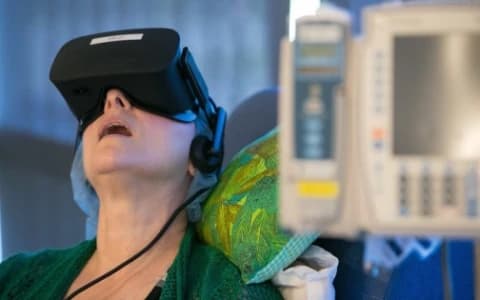
World Cancer Day on 4th February aims to raise awareness of cancer. How can virtual reality technology help?
At TVF, we are passionate about raising awareness of cancer and we are excited to launch our article series on oncology. World Cancer Day on 4th February aims to raise awareness of cancer and to encourage its prevention, detection, and treatment.1 Nearly 10 million people die each year from cancer.1,2 By 2030, it is predicted that cancer deaths will rise to 13 million.1 Although a lot of progress in cancer research and awareness has been made, there is still more to do.
Health messaging via traditional media channels, like television and print, have limited reach as they are now competing with digital platforms for user attention.3,4 Research has also shown that patients struggle to visualise and relate to cancer because of the internal and microscopic scale of the disease.3,5 One of the biggest struggles for people diagnosed with cancer is trying to understand what is happening to them, and up to 80% of the information presented to patients is forgotten.6 Virtual reality (VR) is emerging as an innovative and stimulating tool for raising cancer awareness. VR is able to present information in 3D versus 2D to aid learning and improve memory recall, as supported by many learning theories.3,5 (Read more about learning theory here.)
Get the Skinny on Prevention
In Australia, public health and safety campaigns introduced in the 1980s successfully reduced skin cancer rates.3 However, increased rates of sunburn are being reported by young adults.3 One study developed a VR game for 18 to 35 year olds to teach users about skin cancer.3 The VR game shows a dark pigmented melanoma and allows the user to select treatments, including chemotherapy, targeted therapy, and immunotherapy.3 As the game progresses, the cancer cells become resistant to illustrate the difficulties of treating late-stage cancer.3 The game ends with preventative skin messaging to empower the user to take responsibility for their sun protection behaviours and motivate improved sun protection habits in the future.3 The participants found the game immersive and engaging; they felt like they were inside the body.3 The game simplified complex information and many wanted to talk to others about it.3
Nuts About Detection
Although men report being aware of testicular cancer, their knowledge of cancer risk factors and symptoms may be limited.4 Another study developed a VR experience designed to enhance men’s awareness of testicular disorders (E-MAT).4 The first level places the user in a space with two walnuts representing the testes.4 The user moves around the walnuts to inspect them as a voiceover gives information about the typical size and shape of testes.4 Lumps, swelling, and pain then begin to appear.4 As the user progresses to the second level, a 3D model of a real testis appears and the voiceover links the abnormalities seen in Level 1 with this anatomical structure.4 In the third level, key messages are reiterated, particularly the importance of knowing one’s own testes, performing self-examination and seeking early medical attention for any testicular symptoms.4 All participants found the intervention to be applicable to real life, and nearly all believed they learnt something valuable.4
Out-Of-Body Experience Learning About Treatment
Patients with cancer are often anxious about their treatment or have misconceptions about the technology used.7 A VR experience was built that allows patients to view a virtual simulation of themselves receiving radiotherapy.7 The patient’s own data are converted into a full-scale translucent 3D rendering of their body on a treatment table with their internal organs visible.7 Radiation beams appear in yellow and go through the target volumes according to the patient’s individual treatment plan, allowing the patient to see how the radiation beams are shaped and targeted specifically to the size, shape, and location of their tumour.7 Whilst wearing the VR headset, the patient feels like they are in a radiotherapy treatment vault and can walk around to view the radiotherapy delivery from any angle.7 The patient’s treating radiation oncologist narrates and explains details to the patient in real time as they can view a separate 2D monitor that mirrors the headset view.7 The clinician can encourage the patient to approach their body closer to see small details, such as the separation between the beam edge and their other healthy organs.7 93% of patients agreed that the VR session gave them a better understanding of how radiotherapy will be used to treat their cancer, and it could help reduce their anxiety.7 The VR session also improved communication between the patient and their physician, as it triggered patients to think of additional questions to ask.7
Accessibility Limitations Today, Unlimited Educational Experiences Tomorrow
Health messaging requires novel and engaging strategies to be effective in preventing cancer, improving detection rates, and educating patients about their cancer treatment.3 Research has found high levels of public interest toward VR in a healthcare setting.3 The ability to deploy VR experience within healthcare settings is limited by accessibility to VR equipment; however, VR content can be converted into a 2D desktop PC experience or an augmented reality version on mobiles until VR becomes more accessible.3,7 When designing a VR experience, the humour level, tone and any gaming elements need to be thoughtfully considered so as not to detract from the seriousness of the issue, but the right balance can provide a unique educational and engaging experience for patients.3,4
Visit us again next week for the latest instalment in our oncology series.
By Zoe Wong